KAIST Researchers Unveil R-DM: A Physics-Informed AI for Precision Molecular Design
A research team at the Korea Advanced Institute of Science and Technology (KAIST) has announced the development of the Riemannian Denoising Model (R-DM), a pioneering artificial intelligence architecture designed to solve complex challenges in molecular design. Announced on February 10, 2026, the R-DM represents a significant shift from traditional generative AI, which often struggles to produce chemically stable structures. By integrating the fundamental laws of physics and the principles of Riemannian geometry, the model can predict molecular configurations with a level of precision that approaches quantum mechanical calculations.
The Shift from Shape Mimicry to Physical Understanding
Historically, generative AI models used in drug discovery have functioned primarily through pattern recognition, essentially mimicking the shapes of known molecules without an inherent understanding of why those shapes are stable. This often led to the generation of "hallucinated" molecules—structures that look plausible on a screen but are physically impossible or highly unstable in a laboratory setting. The KAIST team, led by Professor Woo Youn Kim of the Department of Chemistry, addressed this limitation by designing an AI that explicitly considers the energy of the molecule.
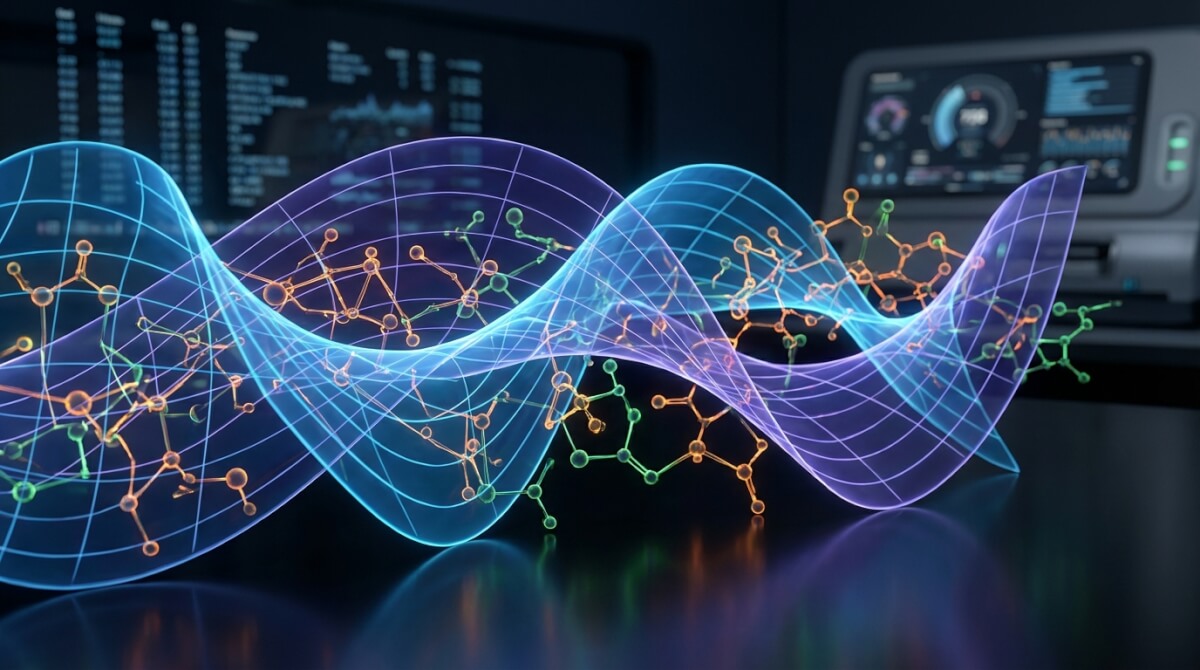
R-DM functions as a physics-informed simulator. Instead of simply placing atoms in 3D space based on statistical probability, it treats the molecular design process as a navigation problem across an "energy landscape." In this landscape, high energy levels are visualized as hills and low energy states as valleys. The AI is trained to autonomously seek out the lowest energy valleys, adhering to the fundamental chemical principle that matter naturally gravitates toward its most stable state.
Navigating Energy Landscapes via Riemannian Geometry
The technical core of R-DM lies in its application of Riemannian geometry, a branch of mathematics that deals with curved spaces. Molecules are not static collections of points; their stability is determined by the complex interplay of forces—such as bond lengths, angles, and non-covalent interactions—acting within a multi-dimensional geometric framework. By utilizing Riemannian geometry, the R-DM can refine molecular structures by calculating the exact forces acting between atoms at every step of the generation process.
This "denoising" process begins with a random, high-energy arrangement of atoms and iteratively moves them toward a stable, low-energy configuration. Because the model understands the underlying physics, it can avoid the structural pitfalls that plague conventional models. According to the research team, this allows the AI to operate not just as a creative generator, but as a rigorous scientific tool that ensures the chemical validity of every output.
Benchmark Performance and Quantum-Level Accuracy
The results of the study, recently published in the journal Nature Computational Science, highlight the model's superior performance compared to existing state-of-the-art AI. In rigorous benchmarking tests, R-DM demonstrated up to 20 times higher accuracy than previous molecular generation models. Perhaps most impressively, the error rates in its predictions were reduced to a level nearly indistinguishable from high-precision quantum mechanical calculations, which are notoriously computationally expensive and time-consuming.
By achieving quantum-level accuracy at the speed of an AI model, R-DM effectively bridges the gap between fast-but-unreliable generative models and slow-but-precise physical simulations. The research was a collaborative effort involving Dr. Jeheon Woo from the KISTI Supercomputing Center and Dr. Seonghwan Kim from the KAIST Innovative New Drug Discovery Center, emphasizing the multidisciplinary nature of this breakthrough.
Broader Implications for Science and Industry
The development of R-DM has profound implications for several high-stakes industries. In pharmaceutical research, the model acts as an "AI simulator" that can dramatically accelerate the identification of drug candidates, potentially reducing the time required for early-stage discovery from years to weeks. Beyond medicine, the technology is poised to impact the following areas:
- Next-Generation Materials: Designing more stable and efficient electrolytes for high-capacity batteries.
- Catalyst Design: Creating high-performance catalysts for green energy production and carbon capture.
- Environmental Safety: Predicting the behavior and degradation paths of hazardous substances in complex environments where laboratory experiments are difficult to conduct.
As the scientific community continues to integrate AI into core research workflows, models like R-DM set a new standard for reliability. By ensuring that artificial intelligence respects the immutable laws of physics, KAIST researchers have provided a robust framework for the next generation of molecular and material innovation.